Wolfram Eilenberger, Time of the Magicians: The Invention of Modern Thought 1919-1929 – Allen Lane, August 2020

OK

stuartelden's avatarProgressive Geographies

Wolfram Eilenberger, Time of the Magicians: The Invention of Modern Thought 1919-1929 – Allen Lane, August 2020
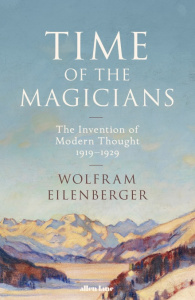
The year is 1919. Walter Benjamin flees his overbearing father to scrape a living as a critic. Ludwig Wittgenstein, scion of one of Europe’s wealthiest families, signs away his inheritance, seeking spiritual clarity. Martin Heidegger renounces his faith and aligns his fortunes with Husserl’s phenomenological school. Ernst Cassirer sketches a new schema of human culture on a cramped Berlin tram. The stage is set for a great intellectual drama. Over the next decade the lives and thought of this quartet will converge and intertwine, as each gains world-historical significance, between them remaking philosophy.

Time of the Magicians brings to life this miraculous burst of intellectual creativity, unparalleled in philosophy’s history, and with it an entire era, from post-war exuberance to economic crisis and the emergence of National Socialism. With great art, Wolfram Eilenberger…

View original post 109 more words

Published by ontic-paraconsistency-of-aesthetically-epistemic-taxonomies

In the role of senior IT / IS Specialist, since Oct. 1988 at Politechnika Warszawska (aka Warsaw Univ. of Technology) Main Library, from 1999 till 2010 I was dealing with content-addressable / semantic networks based taxonomies indispensable in classifying all the incoming information materials in Polish, English, French, German and Russian in the subject areas of mathematics, computing and management. During a parallel stint at International Data Group Poland weekly Computerworld Polska in 1993 - 2002 I was a staff writer and journalist reporting about events of interest for CEO's and CIO's in Polish academic, commercial and industrial institutions and enterprises. Since 1985 I am interested in history of logic, mathematics and computing (history of formal sciences, including mathematical linguistics - in general). During last 15-20 years these interests coalesced into something called cognitive sciences. I am currently preparing a series of papers dealing with challenges to computationalism in philosophy of mind from the multiple standpoints offered by socially constructed (or professional communities' induced) taxonomies / ontologies / worlds / epistemologies.

Leave a comment

Design a site like this with WordPress.com
Get started